Affichage des articles dont le libellé est cinema. Afficher tous les articles

dimanche 4 mars 2012

He is just the picture

I finally saw Martha Marcy May Marlene which is indeed as good a film as the critics said – I wish I had the time to re-watch it and write a proper review in which I could elaborate on the ambiguity the film is based on,  and all the wonderful little details it provides to tell the story of a shattered personality and of an identity meltdown, through mirror plays, memory tricks, merging timelines and madness, and how it manages to create the right atmosphere doing so, but instead here's a link to a spoilerish review from The New Yorker –, and yes Elizabeth Olsen is quite terrific in it, playing a Martha trapped in her broken self, perfectly conveying confusion and conflicting drives, with her paranoia hiding the secret desire to be found, to fit in again...but it's John Hawkes who blew my mind once more. As usual, his performance was powerful but subtle. To me, he is just the picture.

There was nothing cartoonish about the pastoralist sect guru he played, and yet he was totally credible in the role of a community leader; hypersexualized "father" of nubile followers, exuding charisma, virility and menace, but also sweetness (John's smile always makes me melt!) and perversion; appearing both charming and terrifying, caring and creepy. And all of that, without overacting.

No, the part wasn't at all the same as the one he played in Winter's Bone the year before. Uncle Teardrop was a badass and a threatening presence, a hillbilly lone-wolf addicted to meth who inspired fear around him, but he turned out to be someone a girl could count on, especially if they are family. Patrick is quite the opposite, he appears much nicer, almost "normal", a family man watching over his people, but he is much more dangerous; he's a sorcerer who puts on a seduction act and pulls the strings of his admirers; he is bad news for little girls. A true big bad wolf.


John Hawkes doesn't have a lot of screen time but owns any scene he is in (even the orgy scene...he doesn't partake but the picture that stays with you is Patrick watching from the stairs while his puppets are having sex), and the character haunts the film, just like he haunts the girl who is named Martha/Marcy-May/Marlene. His invisible presence is palpable thanks to the mise-en-scène and Olsen's performance.

And of course there's the beautiful, and disturbing, scene in which Patrick plays the guitar and sings "Marcy's Song" (picture above) and the actress on the screen seems to become the girl in the song. It's very well done. John Hawkes looks like a mix of a troubadour, a magus and a predator. The scene also reminded me a little bit of the one from Maria's Lovers, when Keith Carradine serenaded Nastassja Kinski with "Maria's eyes". I think that John has a solo album to be released soon, I hope his cover of Jackson Frank's song will be in it.


 Martha Marcy May Marlene isn't flawless, some of the dialogues could have been better for instance, but for a debut movie it's really really good. I'm glad that one of my favourite actors chose it. Because thanks to his Oscar nomination for Winter's Bone, John Hawkes can choose now, and so far he didn't make many mistakes (okay Contagion wasn't a masterpiece but he had such a small part in it...).

By the way, apparently he has turned down a part in The Walking Dead. Good for him! He's very busy with movies (I'm so looking forward to seeing The Surrogate that some say it gave his career's best role *) and The Walking Dead, whose writing sucks most of the time, doesn't deserve his talent.

Anyway, if John should come back to television, I demand that it would be on Justified !!!!! They keep hiring Deadwood actors, so I'm sure they'd love to have him...and seeing Sol Star (the kindest character on Deadwood and John played him to perfection) and Seth Bullock reunited on screen would make my heart sing.

*PS:  Just read an interview in which John mentioned that his "Deadwood pals"– Earl Brown, who plays Dan Dority, and Robin Weigert, who was Calamity Jane– got small parts in The Surrogate! Some day I should write a blog on why Deadwood was one of the best tv shows ever, perhaps even the best...

dimanche 19 février 2012

Dracula is back!

I watched Tinker, Tailor, Soldier, Spy yesterday at the cinema with a bunch of friends. The film, directed by Tomas Alfredson, is based on one of John Le Carré's novels and adapted for the screen by Peter Straughan and the late Bridget O'Connor.

I really liked it. It's a much better movie than Eastwood's J.Edgar (especially for the use of non-linear narrative and flashbacks!) that I saw two weeks ago, or than The Descendants. And damnit, yes Gary Oldman deserves an oscar!

It's good to see him as the lead in a good movie. It felt like ages since he had a good part in a decent film. He was excellent here, but all the cast was good, especially Benedict Cumberbatch (who, by the way, looks much better as Sherlock than he did with that blond hair!). Apart from the "stars" (Gary Oldman, Colin Firth, John Hurt), the film was filled with familiar faces from tv series (like Ceasar from Rome, or Edith from Downton Abbey!), and everybody was pretty much perfect. Gary delivered a fine, restrained and subtle performance, based on his commanding presence, and all the other actors seemed to tune in according to his acting.

I hadn't read John Le Carré's book so Tinker, Tailor, Soldier, Spy was all about cinematography and acting for me. There's some suspense but it isn't a thriller and Smiley's inquiry --or the reveal about the mole (which wasn't so difficult to figure out given the cast...)-- isn't what makes the film so good. The plot isn't that complex, the film is not hard too understand -- although some people seemed to think so -- but the writing is clever.

It is, mostly, an atmosphere movie about the Bristish Spy World in the early 70's(MI-6 here, is nicknamed The Circus), with good writing, great direction and original shots. I often marvelled at the tracking shots and the frames. I loved the chess metaphor that is the spinal column of the film; I loved that Karla remained an invisible foe since the film was about the "enemy within", the mistrust and betrayals between the agents of the secret service; and I loved that Ann Smiley turned out to be a bit like Columbo's wife!

I loved the design of the set, the costumes and the props too: the control room that looked soundproof (or was it just 70's orange wallpaper?)to prevent leaks; Goerge Smiley's huge glasses that allowed him to watch everybody's moves (and concealed Gary's beautiful blue eyes), espcially since a "circus" is basically a spectacle. I loved the swimming scenes that suggested the "swimming with sharks" expression. Unless it was also a way to show that after a life of working in muddy waters, Smiley needed to cleanse himself?

I loved the other big metaphor, perhaps less obvious than the chess one, the film plays on: the teaching metaphor. It worked on several levels. We've got the mentor-ward duo that George Smiley (Oldman) and Peter Guillam (benedict Cumberbatch) embodie, and through the course of the film Peter learns a hard lesson but it is kinda rewarding in his line of work; and as an echo we've got Peter's partner who is obviously a teacher (we see him marking papers!). But there's also a counterpoint to those relationships with Jim Prideaux's new job, as a teacher, after the Hungarian mess, and the new boy he takes under his wing...He literaly went from Spooks to school!

And there's the film itself teaching the audience a lesson, asking the viewers to pay attention, to be patient...to follow along, like the boys chasing a car.

I have to confess that I also loved that Smiley's former co-worker, Sachs, used the word "under-fucked". It sounds much more accurate than our French expression "mal baisée"!

Above all, I loved how the Circus world was so grey, full of shabby places and civil servants that were everything but glamorous or charistmatic. We were light-years away from Bond movies(in spite of some sex here and there). Don't expect to find some sexy spy in there! And there was little action too, and when it happened (at the beginning mostly) it looked clumsy.

There was violence, for sure, but it was mostly a world of protocols and hierarchy, a world of mere apparachiks, with the highest-ranked ones thinking they were kings and sending pawns like Ricky Tarr (and, to a certain extent, Jim Prideaux) to do the dirty work. But they are just civil servants, playing with the lifes of the others; British men who grew up in those famous Public Schools , work in offices, have affairs and have Christmas parties...

Early on in the movie, we are told that there's "a mole" at the top of the British Intelligence, and the more we see those secret service the more it's obvious that there's indeed something rotten, poisonous, in the Circus world, as if they were all, already, cold spectres. Through its visuals, the actors' performance, and the ambiance they created, the film conveyed very well the mix of spy machinery, lethal skills (Jim and the owl !!!!) , a certain sloppiness -- and the mess that ensues--, and a general state of decay.
The chess pieces move on the checkboards, the main ones deluding themselves into believing they are more than pawns that can be dispatched, disposed and replaced. And this is where the two metaphors merge, for all the pieces will have to face the truth and learn the lesson. Smiley learned it first...

The film is cold and sometimes it feels devoid of human feelings, especially when it comes to the older characters(Peter or Ricky are still "tender meat", young enough to look fresh and human),yet all of those master spies, at some point, became more than their function, lost their self-control and showed some emotion(either when losing their position like a defeated Percy in the rain, or when having their heart broken...). 

Gary Oldman who was very quiet (silent even at the beginning of the film) was a bit like a mummy, wrapped in his beige raincoat, or the avenging ghost coming back to sort things out, to put the Circus to rights, and he slowly came back to life while doing so.

Of course he also turned out to be the best chess player of the game. The scene in which he corners Toby Esterhase and have him yield and beg is very significant. And of course the final chekmate scene is highly ironical given the actor who plays the fallen king and a previous role he played not so long ago...

Tinker, Tailor, Soldier, Spy is the kind of spy movies that I like, gripping and focusing on the Intelligence work rather than on showy action scenes, so obviously the anti-Bourne kind...

I recommend it, but it is not pop-corn movie, people!

dimanche 11 septembre 2011

La fugue du Pape

Habemus Papam is totally my kind of comedy and it might be Moretti's best film to date.

The movie begins with a conclave for the Pope is dead. The famous smoke turns black twice but finally the cardinals manage to choose a Pope. The problem is that cardinal Melville, played by Michel Piccoli, doesn't want to be The One, so the film actually contradicts the "habemus papam" phrase, as the newly elected Pope can't cope with the job and decides to run away; the cardinals remain helpless(the papal curie even asks a shrink to help!) and everybody is left Popeless.

The film is brillant, often touching and funny (irreverent as a comedy must be but not at all the red-hot movie against Vatican and Catholic Church that one would expect from a leftie like Moretti), and Michel Piccoli is fantastic. To think he played Dom Juan so many years ago, and now he's Pope!

Habemus Papam
isn't a film about religion, rather a film on the wish for freedom, illusions, frustation, acting and imitation -- actually it is a sort of movie fugue considering the film's structure and the character's mental state. Moretti mocks the media and communications advisers, makes fun of psychoanalysis and shrinks, and, above all, of himself, and plays with the idea that The Vatican is a big theatre where, when a Pope dies, the show must go on...as long as nobody is miscast.

At the end of the day, art is the answer, or at least a place to find refuge when it's too much. Nanni Moretti tried to fight against Berlusconi and must be very disheartened as nothing has changed in his country,  and he doesn't believe in Heaven, but he has found his haven and it's a nice one.

dimanche 10 juillet 2011

La dernière piste


I went to the movies yesterday evening and saw Meek's Cutoff which is a beautiful beautiful movie.

I'm sure that many people who mostly seek entertainment would find it too slow, and perhaps even boring, and would hate the open ending, completely missing the point that it is ALL about the journey, and that the film is a work of art. It isn't an action movie for sure, but an existential story. Actually, I liked it better than the Coens' True Grit and I'm a fan of the Coens!

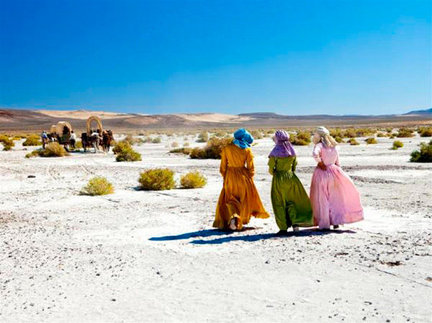
Meek's Cutoff is a great modern western (although it takes place in 1845), renewing and updating the genre by choosing a new point of view (the women's) and getting rid of formula and many cliches, while bringing us back to the roots of the western that are both religious and historical (the Bible and the reality of the conquest of the Wild West)and creating a universal and engrossing tale.

The film manages to convey realism, demystifying the take on those pioneers and a journey that would have been epic in old films -- here, on the contrary, and despite very few close-ups, we get to be close to them, to see the dirt, the doubts, the fears, the sheer craziness, the real tough life of a wagon train, we get to smell the stink even --, while also playing on the metaphorical level.

Apart from the obvious allegorical and biblical side of the journey from the Genesis reading and the garden (the water land), through the desert, to the Tree of Life, a journey in a desert land is a bit like a journey in a labyrinth; it is always metaphorical and cathartic (purgatory-style) on screen (remember Gus Van Sant's wonderful Gerry?), so we see the settlers slowly getting rid of superfluous weights, but the film also tackles the question of power and how it may shift (the subjugated ones may become in charge eventually), and there are the key element of fear and human vulnerability, of being dependent on others for survival, and therefore of trust and distrust.

It's about being a stranger in the strangest land and the theme of otherness is central: men and women are different worlds, set apart and hardly communicating (the men make decisions, the women, mostly going about their chores, follow), which the first part of the film shows very well; Meek, who is supposed to lead the settlers to Oregon and chose that dangerous shortcut, is something of a mystery himself for the immigrants to the point that they begin to suspect he might not know what he is doing or is an evil man so, even though he's somewhat familiar, they consider killing him; and of course there's the Indian who is the ultimate Other of the tale. And then it's all about blood and water, and about whom they can really trust to guide them towards water, to be their saviour.

The screenplay is smart but, above all, the cinematography is just fabulous (at first the square screen is weird but then you forget about it and the pictures are simply breathtaking), the angles, the frame are perfect, the mise-en-scène is clever and the film has the best crossfade I have ever seen, I mean EVER.

At the end of the day, the viewers are like the three foreign families in the wagon trail, trusting some stranger, the director, to take them somewhere, focusing on the destination (the supposed climax and pay-off we expect in adventure movies) but actually forced to go on an uncomfortable journey which takes time, so it can be confusing and you may think that the director has let you down, actually got lost and has gotten you lost in the process. Or like Emily, played by Michelle Williams, you can reject the clueless oldschool cowboy whose leading days are gone, you choose to follow the native person who knows that new land, you start interpretating his/her language, and you trust that he/she will lead you to the refreshing and rewarding water.

Also, on a meta level, one could say that the film is the opposite of Meek's goal and reflects the story showed on screen for there's no cutoff, no easy road, no explanations handed on a plate to the passive audience.

Michelle Williams delivers a good performance (just as a good as the one in Blue Valentine), playing a strong female character that is a nice change from her usual roles, but all the actors are perfectly cast (and the Indian is hot!).

I'm really impressed by Keily Reichardt here, and glad to see that there are great female directors (Debra Granik, Courtney Hunt being other examples) out there, rising in indie movies. Reichardt defies the expectations of the genre, from beginning to end, but she is up to the job of directing the great western of the XXIst century.

lundi 14 février 2011

The woman who sings


The film I saw today is the best film I have seen so far in 2011. It's a movie nobody talks about in the media over here, although it has been nominated for the Oscars in the Best Foreign Language Film category, and, sadly, I think that very few people will see it as not many theatres are showing it in Paris. Yet it's beautiful and unforgettable, both stunning and devastating. I know it will stay with me for a while.

Incendies by Denis Villeneuve is a French Candian film, based on the play by Wajdi Mouawad, that starts in Montreal but mostly takes place in South Lebanon (the country is never named in the film, because it's a timeless drama, nearly mythological, but it's quite obvious we're in Lebanon during the 70's and the 80's from the "refugees camps", the war between" the nationalist Christian militia" and the fedayins...).

Villeneuve provides an original point of view on war (in general, the film isn't a report about the Lebanase civil war) and on motherhood, while reviving Greek tragedy. The shadow of Aeschylus (the Oresteia) and Sophocles does float over this modern drama. The film is also the powerful and poignant portrait of a lady, la femme qui chante.

Everything begins in Canada when twins, Jeanne and Simon Marwan are at the notary office, listening to their late mother's will, a mother who, as hinted, was quite distant. They are given letters by the sollicitor who was also her mother's boss and a family friend, one letter to Jeanne that she's supposed to give to their father, one to Simon which he must give to their brother.

Except that they always believed that their father had died "during the war", and the brother's existence comes as a complete surprise to them!

Simon, still mad at his mother for her failing at the "mother job", is reluctant to accomplish the mission, while Jeanne quickly decides to leave for Middle East. As her journey goes on, she slowly finds out who her mother, Nawal Marwan, really was. While Jeanne travels in that strange land whose language she doesn't speak, looking for clues of her mother's past, we see Nawal's life in flashbacks in the same locations that her daughter visits for the first time. It's Simon who ends the journey with the last finding though.

The cinematography is fantastic without being showy, the editing isn't perfect (especially in the first part of the film)but the mise en scène is great and the cast is excellent. The film was mostly shot in Jordan, and it's a Belgian actress, Lubna Azaba,l who plays Nawal Marwan, delivering a terrific performance. A must see.

PS: Here's a quotation by Wajdi Mouawad, who wrote the play, that sums up why the film is a thing of beauty whereas it's about awful things:

«Le scarabée est un insecte qui se nourrit des excréments d’animaux autrement plus gros que lui. [...] Un artiste est un scarabée qui trouve, dans les excréments mêmes de la société, les aliments nécessaires pour produire les œuvres qui fascinent et bouleversent ses semblables. L’artiste, tel un scarabée, se nourrit de la merde du monde pour lequel il œuvre, et de cette nourriture abjecte il parvient, parfois, à faire jaillir la beauté.»

mercredi 6 octobre 2010

Hopeful

I often lament about the lack of great French writers or great French films these days. Compared to the beginning of the XXth century French literature has been poor for the past decades, and French movies keep disappointing me.

But I've read the interesting and original Mémoire de La Jungle by Tristan Garcia and I'm reading Michel Houellebecq's La Carte et le Territoire, which is really really good. Besides I saw a couple of weeks ago Xavier Beauvois's Des hommes et des Dieux so there's hope still.

No matter what is said about Houellebecq, he is a good writer and true author –– not the likes of Marc Lévy or Anna Gavalda or Amélie Nothomb who sell so many books every year–– and his last book belongs to Literature with a capital L.

As for Des Hommes et des Dieux (Of Gods and Men), it's the best French film I have seen for a very long time. It won Le Grand Prix in Cannes and many critics consider it should have received la Palme d'or instead of Uncle Boonmee (I haven't seen Uncle Boonmee yet so I can't tell). Xavier Beauvois whose Le Petit Lieutenant I enjoyed very much years ago, really turned out to be an amazing film maker.

Go, run if needed, and see this movie! If you are a movie buff you will be thrilled, if you're a believer you will feel warm, and if you're just a human being you will be deeply touched.

By the way, it's funny to think that a movie like this does much more for the Catholic Church and its Christian values, even though it isn't Xavier Beauvois's intent at all, than The Pope's behaviour or speeches.

Des hommes et des dieux tells the story of the Trappist monks from Tibihirine (a monastery in the Atlas) who died in 1996, during those horrible years in Algeria when the F.I.S party, that had been declared outlaw after it had too much success in elections, tried to conquer power using terrorism while the government (ruled since 1962 by one party, the FLN) fought back using similar means. It was a decade of violence and sheer terror for everybody living in Algeria and a lot of blood has been shed. Seven monks (out of the 9 who lived in the monastery then)were among the thousands victims because they decided to stay over there. Finally they were seized by G.I.A (the F.I.S's army) and their heads were found later...

For a long time their death has been a mystery, even though the official version was that the Islamist terrorists killed them. However last year a former French officer from the secret services finally told a judge what he knew from a fellow Algerian officer but had covered until then for the sake of the French-Algerian relationship: it's likely that it's actually "an error" (I don't know the English word for "bavure") from the Algerian army that killed the monks.

That said, the film isn't about the mystery or about who killed the monks. It's about their last days, about the everyday life that was theirs, about brotherhood, harmony and solidarity; about the fraternity within that religious community but also between the monks and their Algerian neighbours who lived in the village nearby and often shared stuff with the friars and whom the Trappists helped but never tried to convert; about the harmony between men from different cultures (an example of peaceful coexistence between religions) and also between men and nature.

Of course the violence surrounding Tibihirine is there and the film doesn't shy away from the consequences of terrorism or the threat of having the military around, but it isn't a study on terrorism or a documentary on the civil war in Algeria.

It's first and foremost about those men, and at some point, despite the liturgy, the religious singing and the habit, you forget that they are monks, you just see how human they are. They don't live or dies as heroes but as men. And they are simply touching.

You can see the trailer on youtube.

The film is beautifully shot and moving but never falls into melodrama; it isn't austere but it isn't a hollywood movie either!

Beauvois films the everyday life of the monks like he filmed the everyday life of a police station in Le Petit Lieutenant. His movie has the realism of a documentary but also the lyricism of an opera. There are the beautiful landscapes of the Atlas, the camera indulging in a contemplative side that suits the Cistercian order; there's the quiet of working the land and another kind of quiet that comes from the hymns they sing; there are also moments of smile and moments of tears.
The cast is brilliant; Michael Lonsdale is a wonderful brother Luc, Lambert Wilson isn't bad as Christian (he's even quite good when he stops watching himself act) and I was impressed by Olivier Rabourdin as brother Christophe (on the picture above). The most beautiful scene in the film, as the monks are having a Last Supper together while listening to The Swan Lake and drinking burgondy wine, is rather daring and could have been terrible but was poignant and powerful. I couldn't help crying then.

Those monks won't be forgotten.

J'ai, il est vrai, un certain penchant pour les moines du fait de ma formation de médiéviste et de ma spécialité. C'est aussi tout le paradoxe de l'athée chez moi qui, pour refuser toute idée de divinité et de transcendance, est néanmoins sensible au sacré.

Et puis les communautés monastiques fascinent du fait de leur clôture.

Pourtant, comme je le disais plus haut, on finit par oublier que ce sont des religieux appartenant à un ordre cistercien de la plus stricte observance. On ne voit plus que leur humanité. Ces hommes ont peur, sont tentés de fuir, ont des faiblesses et des doutes. On aurait pu s'attendre de leur part à une plus grand fascination pour le martyre, et le sujet bien sûr est évoqué, mais le film insiste sur le fait qu'ils n'ont pas envie de mourir. D'ailleurs deux d'entre eux réussissent à se cacher la nuit où les Islamistes débarquent pour les prendre en otages, et survivent ainsi à leurs frères.


Xavier Beauvois réussit le tour de force de faire un film sur le quotidien et l 'intimité de ces Trappistes sans tomber dans la froide observation ni signer une hagiographie ou un film prosélyte. Pour comprendre ces hommes, nul n'est besoin d'être catholique ou même croyant, et s'ils parlent de dieu et de foi (comment pourrait-il en être autrement?), il ne s'agit pas pour le film de faire passer un message religieux. On est bien loin d'un film de propagande ou d'une bondieuserie sur fond de terrorisme. Le film parle des hommes et non des dieux, et c'est en révélant ces hommes, et l'amour qui les unit, que Xavier Beauvois finalement montre ce qu'est la foi.

Les différentes personnalités des moines sont ainsi révélées sans grands discours mais par le biais de petits détails ou grâce à l'interprétation habitée des acteurs. On devine que certains d'entre eux ont eu une vie "normale" avant d'entrer en religion; on comprend que les choix ne sont jamais simples, même pour des hommes qui ont voué leur vie à une mission.

Que de grâce et de pudeur dans ce film, dans la manière dont la caméra filme les êtres, que ce soit dans les scènes intérieures ou extérieures. Beauvois n'a jamais recours aux grosses ficelles mais s'attache à soigner l'esthétique de son film. Les relations entre les individus sont subtilement montrées, qu'il s'agisse des moines entre eux (merveilleuse scène de vaisselle entre Luc et Christophe!), ou des moines avec les villageois musulmans. Les scènes où frère Luc, qui est médecin, s'occupe des villageois–– ou même d'un terroriste blessé–– dans son dispensaire, ou ces instants qui mettent en scène une jeune fille du village bavardant ou travaillant avec un moine sont simples et beaux, et constituent un parfait contrepoint aux offices très ritualisés et aux scènes de psaumes à l'intérieur du monastère.

On comprend peu à peu que ces hommes qui ont fait un choix de vie assez fou en partant vivre dans ce lieu isolé de l' Atlas, se sont libérés des étiquettes habituelles. Sont-ils encore Français? Se considèrent-ils comme Trappistes? Comme Chrétiens par opposition aux Musulmans qui les entourent? C'est peu probable. Ils n'appartiennent plus qu'à une mission spirituelle, à un idéal de fraternité qui les attache à une terre et à d'autres hommes, rendant la fuite impossible (la tentation de se sauver est forte pour certains, mais cela signifierait abandonner les frères, ceux du monastère et ceux du village), et paradoxalement cette mission et cette spiritualité les incarnent.

Ils sont "en religion" au sens étymologique du terme (selon St Augustin et non pas Cicéron), reliés au sein de leur communauté de Tibhirine entre eux (d'ailleurs les contacts physiques augmentent au fil du film) et à leur dieu (mais celui-ci reste dans l'arrière-plan), et reliés au reste du genre humain (y compris les Islamistes qui tuent et égorgent), mais délivrés de toutes autres entraves; ils sont au service du monde et des autres (et l'autre c'est d'abord ces Musulmans qui vivent près d'eux); ainsi le dit avec malice frère Luc, interprété par le magistral Michael Lonsdale (magistral à l'écran mais en piteux état dans la vie réelle pour ce que j'ai pu voir il y a quelques mois quand je l'ai croisé dans le métro), "laissez-passer l'homme libre".

Des hommes libres, insoumis, que la menace des armes ne peut faire céder, c'est ce qu'ils deviennent tous en fin de compte. L'idéal de fraternité est omniprésent dans le film mais l'essence de leur foi semble résider dans ce libre-arbitre qu'ils défendent. Être libre procure de la joie mais a un prix, ce que la fameuse scène de leur ultime repas, véritable Cène moderne sur la musique de Tchaïkovsky, montre bien, alors que la caméra se rapproche des visages et plonge enfin dans les regards. Cette scène est incroyable, c'est un véritable tsunami émotionnel.

J'aime ce film précisément parce qu'il n'est pas religieux, mais républicain, et c'est en Algérie (au Maroc en fait) qu'il nous parle de ce devrait être la France. Dans un article Xavier Beauvois a d'ailleurs déclaré que la devise "Liberté, égalité, fraternité" pouvait résumer son film.

Le seul reproche que j'aurais à formuler concerne la voix off, tirée des écrits de frère Christian, à la fin du film. Le moine écrivait bien mais le texte paraît redondant, et j'aurais préféré voir simplement la colonne des moines et de leurs ravisseurs disparaître dans la brume neigeuse de l'Atlas, marchant vers un destin tragique que l'on connait déjà mais dont les détails resteront mystérieux.

Mais on dirait que lorsqu'il s'agit de parler de foi, les images ne suffisent plus et il faut, qu'au final, le Verbe soit.

dimanche 14 février 2010

Accept the mystery !

I saw A Serious Man yesterday and it's simply excellent!

It's one of the best films the very talented Brother Coens(or Coen Brothers), two of the greatest filmakers of all time, ever made. It's cleverly written (they'd better win the award of best scenario!), cerebral, beautifully shot, well-played and, although it sort of belongs to the film noir genre, it is also very funny (the sequence telling the story of the goys' teeth is hilarious).

The opening sequence is brilliant and a daring prologue. Like a Jewish tale meant to Enlighten, it takes place in the old Eastern Europe (probably a shtetl from the 19th century)so many American Jews came from, and all the dialogues are in Yiddish.

Then we find ourselves in the 60's and follow Larry Gopnik and his family in a Minneapolis' suburb. The brothers Coens grew up in such environment; their father was a college teacher like Larry, and they had to go to Hebrew School like the young characters in the film while they couldn't care less about religion and were rather into pop culture and Jefferson Plane's songs, so it's the most autobiographical movie in their work, but there's much more in this film than just an acid portrait of the American Jewish families and community in the Midwest. In a way their childhood is like a dibbouk that came back to haunt their film, but like the macabre opening scene in the shtetl, the Coens' background gives us keys to parse their work.

In the movie, Larry Gopnik's life (both personal and professional) is slowly turning into a nightmare, just falling apart, and there's nobody to support him, so he visits three rabbis in an increasingly vain attempt to find answers and solve his crisis. His journey is therefore divided in three acts, each separeted by a black screen...which is quite nihilistic but fits in the Coens' world!

The film opens with a quote from rabbi Rashi (a medieval French rabbi whose exegesis work I've come to know thanks to Daniel Mendelsohn's The Lost!): "Receive with simplicity everything that happens to you".

Also, Larry, being a Quantum Physics teacher, briefly reminds us, through two of his lectures (one is a dream sequence though) of Shrödinger's Cat and Heisenberg's uncertainty principle that both find many echoes in the rest of the movie. But it's a Korean student (who tries to bribe Larry to change a F into a C so he would pass!) who sums it up when saying "accept the mystery", a true rabbinic line, which was smart and interesting to put in this morally-challenged Asian mouth (but as rabbi Nachtner suggested through the dentist' story sometimes there are important messages in goys' mouth!)!

It isn't only a Jewish precept in order to be a "serious man" that would live his life without questioning Hashem's plan, it is something that defines the Coens' art and the reason I love their films (well, most of them): they don't feel the need to explain everything to the audience, to provide answers. Perhaps the matter of being "a serious man" has less to do with the characters in the film, and more with the viewers.

I am not a Jew, but cinema is my religion, and the Coens can be my storytelling rabbis any time!

mardi 29 décembre 2009

Clair-obscur


Yesterday I watched Francis Ford Coppola's Tetro. Now that's a real movie and a very good one!

I wouldn't call it a masterpiece for it has a few little flaws, but it's definitely a film worth watching and one of the best Coppola ever made. I highly recommend it. This is a personal work, fed with private stuff, but this is mostly the film wherein Coppola shows his love for the movies and how he's mastered the art.

The black and white photo(the flashbacks or the "quotations" only are showed in colour, colours that look quaint compared to the timeless w&b) is gorgeous and conveys the right intimacy and modesty the story required; the cinematography is beautiful (hey people no need to have fancy special effects, 3-D and Pandora's ecosystem to provide lovely visuals, creativity and style !!!!); there's a real scenario, smart writing; there's imagination, and the cast is really good.
I wish people would see films like this rather than just watch Summer blockbusters or hyped movies supported by Internet buzz.

"Tetro" means either sad or dark in Italian...wich perfectly defines Vincent Gallo's character who goes by that name. In the movie Tetro is also short for Tetrocini which is actually the character's last name or rather his patronymic name.

In Buenos Aires, a young sailor (still a boy since his 18th birthday happens during the film), Benjamin Tetrocini, turns up at his long lost brother's place. The 20-year-older brother is a broken man/artist who has given up his literary ambitions and now lives with a woman who used to be his doctor in the asylum he had ended up. He has cut all the family bounds, changed his name (Angelo became Tetro), works as a mere electrician (he is dark but he is the one providing the light!) and doesn't seem happy to see his baby brother. But Bennie needs answers and takes roots. Slowly the past unfolds and the truth is unveiled, glaring like a dangerous dazzling light in the dark ...

In Tetro, Coppola deals with his favourite theme–– that is family, and shapes the storylines and characters after personal stuff(relationships between his father and uncle, between his own brother and him). Some things were already there in his previous films (The Godfather of course, but also Rusty James) but it was less obvious. Looks like that being in his 70's now he's free to tell the story he has always wanted to tell, and he does it in a brilliant and very modern way. Bravo maestro!

I loved the Buenos Aires atmosphere, the way American, Spanish and Italian influences merged. I loved the play on mirrors, the reflections and parallels (Argentina is Borges' homeland after all!)and how Coppola eventually avoided a mere reproduction, how he twisted certain parallels; I loved how the filmaker confused the audience, about the time the action takes place, about certain characters who look alike: I loved how, while he was telling intimate stuff, he indulged in using operatic pieces and mise en abîme, either extracts from old movies (paying a tribute to Michael Powell by mentioning The Red Shoes and showing bits from The Tales of Hoffman) or ludicrous play scenes and dancing moments that were nothing but a meta commentary. Sometimes the film reminded me of Almodovar's work, sometimes it called to my mind Tennesse Williams or Rocco and his brothers.

Tetro is a men's film. A film about brothers, about fathers and sons, about male artists that struggle to assert themselves. The women are there, of course, but there are mostly dolls, like the broken Coppelia (even though Coppelia is also a metaphor for Gallo's character) or the women in Greek tragedies, doomed to love.

Newcomer Alden Ehrenreich is touching and does sort of look like young Leonardo DiCaprio under certain angles yet he's tougher (actually he embodies Dalida's famous song: "Il venait d'avoir dix huit ans, il était beau comme un enfant, fort come un homme"...) . Klaus Maria Brandauer is perfect as the Great One, the tyrannic patriarch and charming ogre (an avatar of some of Coppola's relatives but also of Coppola's himself!). And Vincent Gallo is very good as Tetro. Apart from his performance he is too handsome for words. Damn he's aged well! The camera loves his face and so do I.

He is simply entrancing.

samedi 3 octobre 2009

Little women

Yesterday I saw another of the Cannes films that won a prize. It's the British Fish Tank, and again its Prix du Jury is well deserved. That portrait of a teenage girl won't be forgotten.

Mia is a rebellious British teenager whose life isn't a piece of cake. Actually it sucks a lot. You wouldn't want to live in that Essex housing estate that is her fish tank. As for her family, it sucks too, her mother (the wonderful actress that starred in Loach's Its a Free World) wouldn't get a prize in parenting, and her little sister has a filthy mouth(yes the film is filled by bad language from all the female characters but the little sister delivers a very creative coarse language and is hilarious). The three females basically keep insulting each other all the time. Mia doesn't go to school anymore and she doesn't have any friends left. The 15 year old Mia is alone, feeling awful –she hides her body beneath shapeless sportswear just like she hides her softer side–reckless and restless.

The fish tank is the metaphor of the many cages Mia wants to escape. One of the them is her own body, hence her drinking booze (something her mother must have passed on her), her practicing hip-hop dance when nobody watches, and her trying to free a white horse who's chained up by some gypsies in a wasteground. One day a man shows up in the flat and sees her; Connor a hunk whom Mia's mother has brought back. His arrival leads to new possibilies, hope and, perhaps, disappointments.When I read that Mia had a secret passion for dancing and dreamed of becoming a hip-hop dancer, I was afraid that Fish Tank might be some sort of female Billy Eliott, a politicaly correct feel-good movie that would turn into a fairy tale, but it is not. The music has a role to play but Mia's passion isn't the stuff the film is made on. Also even though the film obviously belongs to the "social realism" family like the ones by Ken Loach or Mike Leigh(the plot takes place in a dirty and hopeless neighbourhood), it has its own style. It doesn't shy away from the ugly truth but it doesn't convey a political message, doesn't make a social statement. It's definitely a woman film, not only because the lead character is a 15 year old girl or the director is a woman(Andrea Arnold), but also because it's about the birth of a woman and about female desire.

There's such a sensuality in the way the camera films everything. It makes the audience feels what Mira feels, the breath she tries to catch, the fragrants she inhales, the skin that is touched, whatever Mia smells or tastes.

Michael Fassenber, who plays Connor, is again terrific (that actor never ceases to amaze me) and he's quite perfect as the male object of desire, so nice a guy but oh so disturbing. In the first scene he appears in, you can't help feeling like Mia and staring at that half-naked body. The sexual tension between Mia and Connor is really well done, not in the usual cliched way. Not many films have been made on female desire and even fewer have been made on a teenage girl's sexual awakening (I can think of Splendor in the Grass but Nathalie Wood's character was older, I guess), on the burgeoning female sexuality. Because in this film, even though it's obvious that the attraction and feelings are mutual(Mia and Connor do like each other) to the point of their crossing the line one night(while the pastered mother has passed out), it isn't much about a forbidden love nor about a man falling for his mistress' daughter, it's about Mia becoming a woman, about her leaving the fish tank.

Of course things aren't that simple and Connor isn't the key of her freeing for he isn't as nice as she(we)'d like him to be; he is just a tool in her metamorphosis, of her moving on past her chrysalis state. What I enjoyed in the movie is the lack of over-simplification. We get to see the dirty and the beautiful, the light and the dark side of every character, their strength and weaknesses. Anyway the film always avoids the easy route.So definitely not a fairy tale but not a depressing movie either, there's tenderness still and some sort of moral code remains, even there, even then.

lundi 1 juin 2009

From despair to hope

At first glance, Ken Loach and Eric Cantona make an unlikley pairing. Yet Loach is a football lover and Cantona, who has always been a peculiar footballer and has re-invented himself as actor/painter/photographer/poet, says he admires the British film-maker.

I am not a football watcher but ironically I watched Looking for Eric at the end of the week that saw Barcelona beat Manchester United. To all the MU supporters I say, go and watch Loach's movie you may recover from grief.

In Cannes Ken Loach said "at the game you go from despair to hope to triumph to sadness to elation within an hour and three quarters. If a film could achieve that, it'd be some film". So Looking for Eric may have more to do with cinema than with footbal, fan attitude or Eric Cantona at the end of the day. It is said that Cantona himself ordered it. He wanted a film to pay a tribute to a former fan of his, a postman from Manchester. Loach obliged but he somehow managed to make a film that isn't that far from his usual world.

Our main protagonist is called Eric Bishop, a postman, a good man who has very little self-esteem left, whose whole life is a mess. The first scene shows him driving like a mad man, backwards around the same roundabout, over and over, ready to end his misery and himself. In one scene later, Eric reveals he screwed up his life a long time ago and has been pretending for years. Eric is lost; his friends/colleagues are worried, they think he needs laughter. But he is not alone and he's going to find himself again eventually. From despair to hope indeed. Meanwhile the audience will be entertained and will even laugh.

Yes Looking for Eric is an enjoyable moment, a comedy rather than a tragedy, and for once in Ken Loach's work there's a good amount of light — in every sense of the word–despite some dark powerful moments, but it isn't just a feel-good movie and the Trotskyist film maker doesn't forget his social preoccupations and his political statements.

Yes Cantona has charisma and provides many smiles thanks to all the "cantonaisms"(those aphorisms he became famous for) Paul Laverty wrote for him. It's a lot of fun to watch him play with his public image, uttering "his proverbs and fucking philosophy" as Eric Bishop says – asking his revered hero to stop that bullshit for he already needed years to recover from the bloody seagulls!– and, in the end, laugh of himself. By the way the seagulls stuff– which is showed at the end of the film during the credits– wasn't that cryptic, the metaphor was quite obvious, it's the moment that felt quirky and made it sound like a nonsense. Cantona suddenly became a character from Lewis Carroll.

Movie-buff people make reference to Capra, but I guess that Ken Loach may have thought of Alice when he made the film because, following the unusual fantasy road, he takes both Eric Bishop and us for a "through the looking-glass" journey, backwards-style, in Cantonaland, with Eric Cantona showing up in Eric's room to become his existential guru. There's a Cheshire cat in that Eric!

Don't worry Ken Loach hasn't been damaged by the Twilight fever, he didn't swap social realism for fantastic; the trick is explained early enough at the beginning of the film when one of Eric's mates, who's fond of psychological and self-coaching books, suggests a group session. Everyone is supposed to think of an imaginary mirror and must focus on someone who loves them before looking at themselves through the eyes of someone they love and admire above all. For Eric Bishop it's Cantona!
Later, as Eric is smoking a joint and having a solitary self-pity session, the life-sized poster of Eric The King starts working as said mirror...and there he appears, bigger than life, the genie from the pot!

The film has flaws, the pace isn't perfect, some scenes lack subtlety, and the key metaphor of "the pass" being more important than the goal is a bit heavy, but I like the idea of the mirror, its mischievousness, and the dummy move it represents. The Cantona/Bishop scenes are basically an inner dialogue, Eric borrowing his idol's appearance to deal with everything he goes through, but there's more. Behind the ghost-idol who plays the charismatic and convenient life coach, there's Lily, Eric's first wife, the one whom he left but never stopped loving, the one who loved him more than anything and whom he hasn't faced for years despite their having a daughter.

The film is about love, about family, about solidarity, about trusting your partners, your team mates. Of course Loach can't help delivering a few kicks at football market, sponsors and fucking Murdoch, pointing out that postmen can't afford tickets and can only watch games on tv, but this isn't really a film about football per se.

The film surpises because it seems like a parenthèse ensoleillée in Loach's career, but I think it is nothing that the reverse side of the same coin. Heads or tails, the Death kept asking in the Coens' movie, No Country for Old Men, and once only the toss allowed a happy ending. Most of the time, it's hopeless and ends tragically because of the forces of F (Fate or Free Market), but this time, despite the personal pains and the general crisis (perhaps thanks to it actually), for once, it came down smiling heads for Ken Loach's characters. I won't blame him for indulging in a moment of optimism. Even the most realist ones among us need it from time to time.

In Loach's previous film, the brilliant and depressing It's A Free World – clearly not as uplifting but a better film than Looking for Eric– Ken Loach exposed a system based on the triumph of individualism, on the poor exploiting the poorer, leaving the audience with only their eyes to cry; here he celebrates the collective which makes the most vulnerable suddenly stronger. The "Operation Cantona" scene, besides being very funny("I will find you...because I'm a postman!"), says it all. Eric had to wear a mask before he could find himself again and put his blue shoes on; safety is possible provided that you're stay together; true glory is revealed in taking the risk of supporting the others; victory comes from the pass; brotherhood may overcome; salvation lies in the collective; lost love can be found again.

Looks like that, despite his ability to face this free world and tell it as he sees it, Ken Loach is hopeful yet.

lundi 9 février 2009

Arise, arise, ye subterranean winds

Hurry up, planes, the winds are getting insane!


Both Orly and Roissy Charles de Gaulle airports will be closing at 20:00, because of the upcoming tempest. Paris will become an island on which no ship shall land.


Next the Seine will be coloured in blood and it will rain frogs and locusts.

No movie going then, it's a stay-at-home night. I'm debating with myself whether to watch Dial M for Murder on Paris Première or to start reading Henning Mankell's last novel, Kennedy's brain.

I have vague memories of Dial M and as I really enjoyed watching Shadow of a Doubt that was showed weeks ago this might be a fitting evening for some tense Hitchcock flick .

Hopefully soon, following Ariel, we'll sing along


Dry those eyes which are o'erflowing,
All your storms are overblowing.
While you in this isle are biding,
You shall feast without providing,
Ev'ry dainty you can think of,
Ev'ry wine that you can drink of,
Shall be yours and want shall shun you,
Cere's blessing too is on you.

dimanche 8 février 2009

Botox movie

The strange case of Benjamin Button is...boring. No, I don't think it's a masterpiece at all. The idea of the man born old and aging backwards was an interesting premise but the film doesn't deliver. The actors do their best but all those special effects and heavy makeup that disrupt time, and distort flesh and bodies, actually make the film as expressionless as a lifted face. It was often pointless and obvious.

Besides there was something I didn't like at all but I can't really put my finger on it. I have yet to read Fitzgerald 's short story but I think that David Fincher indulged in a soppy fantasy fable, a sentimental movie borrowing from too many genres at once, but eventually he missed the true tragedy that lies in living à rebours.

I found much more poignant the story of the girl suffering from the Merlin syndrome that Dan Simmons told in his Hyperion Cantos. I even cried reading it.

Slumdog Millionaire and Milk are next on my to-see list.

jeudi 15 janvier 2009

A Christmas Tale

As debut movies go, Frozen River isn't a bad one. Some would say that it is a thriller, others that it is a social drama, and it is not untrue on both accounts, but I prefer to say that it is a women movie – written and directed by a woman, telling the story of two women (the actresses are terrific)and, I guess, most likely to move women at the end of the day– and it is also an American movie. Not just American as being an Indie film from the U.S.A taking place in America and starring American actors, but as dealing with typically American themes.
The Frozen River of the title is the St Lawrence river between The U.S and Canada. Ray Eddy is a "mère courage", a middle-aged woman who's struggling to make a living with a part-time retail job, raising two sons (one is 15, the other is 5) in a squalid modular home while dreaming of a new doublewide...except that we find out at the beginning of the movie that her husband took off with the down payment for the new "house". One day, she comes across Lila, a Mohawk girl from the reservation that straddles the US-Canadian border. Lila lives in a caravan and gets Ray involved, against her will, in smuggling illegal immigrants. Christmas approaches, Ray can barely feed her kids (they subsist on pop-corn and drink Tang!), let alone pay the doublewide of her dreams or even a Christmas gift for her youngest son; her eldest tries to be the man of the house but worries that without money they might lose their rent-to-own television. Reluctantly first Ray teams up with Lila and the two of them begin to make runs across the frozen river carrying illegal Chinese and Pakistani immigrants, doomed to be slaves, in the trunk of Ray's Dodge Spirit.
For a little while I thought that this movie was the American equivalent of Ken Loach's It's a Free World (one of the first films I saw last year), for it also shows precarious situations, vulnerable women, and how the poor make money on exploiting the poorer, but it's actually quite different. Ken Loach exposed a general situation, a system of exploitation, through the storyline of a woman, Angie, who was the product of such system. He did it compassionately but the movie was utterly depressing. Angie was not a bad person per se, she was just a human being who mirrored the society in which she lived, the individualistic generation she belonged to. While being a formerly-exploited exploiter, while being a bit greedy to say the truth, while being ready to do anything in regards to morality, she was also vulnerable, because there were much bigger fishes, people higher than her in the chain food, who could crush her any time; she was vulnerable also because she belonged to the weaker gender in a men's world and because she was a mother who had to care for her son first. And it's precisely her vulnerability, the fact that she could be treated badly (beaten even) and was insecure in life, that made her become a ruthless buisness woman who would give herself all the means to have her share of the loot in this Free World.
In Frozen River Courtney Hunt doesn't expose any economic system, she just shows how hard life can be for the outcast (either white or Indian) and how quickly things can go downhill. The husband who deserted his family was a gambler. He deprived wife and sons of the money they desperately needed, because of his addiction.
He was a sinner and kind of forced his wife into criminal activities, if only because he left behind him, with the keys inside, the Dodge Spirit that Lila needed and found after he took a bus to Atlantic City; the car that Ray didn't want to lose; the car that brought the two women together and led them on the river. We're told that young Lila got in trouble with the tribe's chiefs, possibly after she caused her husband's death, and that her mother-in-law stole her newborn baby, hence her living alone in a caravan. Human smuggling is the way she's found to help caring for the child she can't raise, a way to be a mother nonetheless. As she voluntarily crosses the river for the third time, during Christmas night, Ray almost commits the sin of sins. There's punishment yet redemption is possible through sacrifice, miracles happen, and there's still a place for hope beneath the ice. Humanity may overcome...Halleluja.
Frozen River is my first movie of the year. Not many films take place in the harsh, bleak climate of upstate New York, near the Canadian border. I liked the idea of dealing with that border instead of the US-Mexican one for once and I liked the title; the film doesn't only provide a refreshing glimpse into illegal immigration, it also deals with the communities issue, hostility and prejudices natives and whites have for each others. It shows that the Mohawk nation has a real sovereignty it protects fiercely. And it shows the American wilderness, those wide spaces we, Europeans, can't really grasp. Above all I liked the fact that the smuggling happens through a frozen river that turns into an ice desert wherein it's easy to get lost, a true no-man's land(both women are sans homme)– although it's part of the Mohawk Land–because deserts are often the best metaphorical places to tell a journey; I enjoyed the performances of the lead actresses and was touched by Ray and Lila's final interaction (yes I cried). Frozen River is definitely worth watching.
However, I can't help thinking that there's something much more daring and cutting, darker and much more necessary, and eventually stronger, in Ken Loach's not-feel-good movie.

samedi 27 décembre 2008

Cet obscur objet du désir


I should know it. Christmas time rarely makes for good cinema.
Do you remember Alfred Hitchcock's Marnie? The main character, Marnie, was a thief but, above all, she was frigid. To make his point, Hitchcock gave her Sean Connery as husband and showed her throwing herself into a swimming pool after he imposed conjugal duty. She'd rather drown than touch Sean Connery or be touched by him. That woman obviously had a huge problem!


Well, Australia is a sort of libido test for heterosexual women too. If you're capable of watching that almost 3 hour film until the end, chuckling instead of sighing over it, your libido is just fine...


I wish I could say something kind about the film, but as films go it sucks. It's nothing like Gone With The Wind and Kidman's character is nothing like Scarlett O'Hara. I don't have any problem with genre and entertainment per se, I have a problem with bad writing and bad cinematography. In that regard, Australia does everything that should be forbidden in a cinema class. All the movie cliches are there. All of them! The postcard-like shots, the ridiculous slow-motions, the slushy music to emphasize emotional moments, the stereotyped situations, the laughable camera angles, the overused lines. Some movies do that on purpose, selling themselves as parodies–like that western starring Sharon Stone and Russel Crowe that was a tribute to Spaghetti westerns, or even like Van Helsing, two movies that were a lot of fun– but Australia isn't supposed to be a parody. It's a wannabe-saga-epic-romance film. As such, it failed completely.
Wanna see a good Australian movie on the issue of stolen mixed-blood children? Watch The Rabbit Proof Fence ! Now that's epic, inspired, moving, heartbreaking yet uplifting and beautiful. I know that Baz Luhrmann's idea wasn't to show reality but to portray a mythologised Australia: fine! but mythology doesn't necessarily mean artificial cinema, kitsch and clichés. The boy was cute but I wasn't moved by his story, and the romance did nothing to me.
However, I watched Australia until the final credits, because while one half of my brain–the thinking one, was processing the commonplaces and mocking the bad stuff, the other half–the basic one that is obviously ruled by urges, kept telling the former"Oh shut up and enjoy the pretty! Look at these arms, look at his arse, look at this hairy torso! Wow...Oh dimples!".
Hugh Jackman is the embodiment of the handsome manly man here. His character doesn't even need a name for he isn't really a character but an archetype. He's the Drover; the drool-inducing drover. I already found him very attractive, we all already knew he had an incredible body– his good looks had been used on screen before – but this film goes beyond the usual stuff. Anything Jackman does here, either he sits or stands up or walks or rides a horse or lies down, or just stands against a tree, he does it in a sexy way that makes you wish to become that seat, that pair of trousers, that ground, that horse or that tree. Actually he keeps posing and showing off his perfect body during the whole movie; whether he's filmed from the front or from the back or from the side, or from below, he exudes confident manliness, oozes sex-appeal; whether he's dressed or shirtless, bearded or shaved clean, wet or dry, he's handsome and just hot; actually anything Jackman-related is testosterony, sensual, pure rowrrrrrrrrrr, shot to make us swoon and fan ourselves. He is the eternal man, the Man of the Dreaming–note that this is my only attempt to connect the silly writing to actual Aboriginal culture.

I know movies whose main goal was to flatter an actress whom the filmmaker was usually in love with, but it's probably the first time I see a film that is a nearly 3 hour advert for a sort of manly perfection, a male sex object. And the villain is played by David Wenham, the wonderful Faramir from The Lord of The Ring, who isn't hard on the eyes either...

So yes, I'm guilty of putting aside my cinema expectations and switching onto lust-mode. Sometimes, because it's Christmas, you just want to forget the poor stuff, focus on the pleasant things, lie back half-satisfied, and purr.

mardi 2 décembre 2008

Unforgettable


On Sunday I saw Hunger. It was grey and cold, I was moody so it sounded like a good idea at the time.


What a movie! It's both gruesome and stunning. Steve McQueen never made a film before but he definitely knows his way around a camera! He teaches a lesson of cinema here and didn't win the camera d'or (the prize rewarding a debut film) in Cannes for nothing! I tell you, a talented film maker is born.


The actor who plays Bobby Sands, Michael Fassbender, has an incredible screen presence that gets more and more palpable as he loses more and more weight, but to me it's all about the scenario, the mise en scène and the cinematography.
They made some almost unbearable scenes watchable. I know that some people think it's too arty given the topic, but I was glad for that artistry, especially since it doesn't soften the horror, the raw violence displayed on screen. I don't like films whose only goal is to shock and hurt the audience (Here I'm thinking of Hanecke and his La Pianiste). Hunger is intense and hard to take for it doesn't spare the viewers the most awful details about the way IRA prisoners were treated by the guards in the Maze, about the dirty strike and the hunger strike, and about Bobby's final death, yet it remains a beautiful work of art. Even shit and piss end up looking beautiful. Can you imagine that? Some contemporary so-called artists make utter crap and call it art, this film maker turns supposed shit into art. McQueen is an alchemist!

However, the central piece is neither about prisoners being regularly beaten up and living among feces and worms, nor about Bobby starving himself to death, it's a 15 minutes conversation between Michael Fassbender and Liam Cunnigham who plays someone working in "the business of soul", that is the prison's priest(see the picture above). It's dialectical but it could be an interior monologue as well. That scene is a purple passage, almost a sequence shot. Brilliant! There's even humour in the scene, as Bobby, who's used to smoking the Bible pages, nicks the priest's cigarettes to spare the Book of John!
I guess it's easier to see and enjoy the film for what it is, when you don't have any personal baggage concerning IRA; some British people already resent Hunger, accusing Steve McQueen of propaganda, but I didn't take it that way. The film maker doesn't support Bobby's cause or actions. Yes there's the scene I mentioned above, in which he shows him arguing and justifying his choices, including the hunger strike, and I guess we could call it apologetic, but Bobby is confronted with the priest's rhetoric then, so it's pretty balanced. We mostly see a desperate man trying to give a meaning to his life.

I admit that "the magic of cinema" tends to turn any lead character into a sort of hero, especially when such character is played by a handsome guy who ends up looking Christ-like because of the hunger strike. But it isn't a biopic, and symbolism matters more than who Bobby Sands really was, more than his agony. By the way, the film doesn't begin with Bobby, whose introduction happens much later, but with other characters, first and foremost a guard with injured knuckles.
To me it doesn't say "look at this man who is a true martyr", it's a film showing tormented souls, showing what human beings are capable to do to themselves–and with "themselves" I mean their own person but also their close relations and their kind– and the horrible situations they can find themselves stuck in, for various reasons that they all might find right at the time. And that's a reflection that we need nowadays more than ever.

One scene that truly moves me shows a young guard finally breaking down as his colleagues unleash violence and go wild on the prisoners. It points out that crimes against humanity destroy the torturers too. It goes well with the symbolism of Bobby Sands destroying his body through hunger strike.
The film maker tells a story that obviously left a mark on him as a British man, but he doesn't really take sides and he doesn't shy away from the violence of the IRA militia when he shows one of the guards being killed by a bullet in the head, while he is visiting his senile mother in an old people's home, his blood splashing on her forgetful face, his head falling dead onto her still lap. A shocking scene too.

Eventually if McQueen had an agenda, it isn't about glorifying Bobby Sands, but it might be about putting recent events into perspective(Abu Graib, Gunatanamo...), and it's pretty much about addressing to She whose voice is heard several times during the film, but who is never there of course.
As for me, I wouldn't mind if Margaret Thatcher were forced into watching Hunger...

vendredi 21 novembre 2008

what's in a brain ?


A few days ago I watched the last Eastwood's film, Changeling –watchable enough but not his best work, Clint still knows how to shoot but hasn't been really inspired for a while, and he now indulges in many facilities–and, as I was sitting in the theatre it called to my mind the book I've been reading since last week. In Changeling, Christine Collins (Angelina Jolie)'son is kidnapped. The LAPD (already as corrupted as in a James Ellroy's crime novel) needs some good media coverage and decides to show off a solved case by bringing the boy back to his desperate mother, but, as the kid returns home, Christine Collins doesn't recognize him, and insists on saying that the boy who claims to be Walter, isn't her son but a fraud. When she becomes too vocal, and therefore embarrassing, she's thrown into a mental institution. But of course she's right, her cause is just and Hollywood demands that justice must be done.

In Richard Powers' The Echo Maker, Mark, one of the central characters/voices suffers from Capgras syndrome. After a car accident, Mark emerged from a coma, recognizing everybody but his most beloved ones: his sister Karin and his dog Blackie. To his eyes they look like almost perfect doubles of the sister and pet he cherished, and he's convinced that they are impostors. Soon, in order to explain the emotional disconnection he feels, he considers himself to be the victim of a huge conspiracy.

But there's much more in this wonderful book than a mere neurological thriller. There are echoes within echoes, several sorts of disconnection, various degrees of a more general condition, interlocked metaphors.
Without stating it, Richard Powers literally auscultates the post-9/11 America. The cranes' migration is a key metaphor the whole book is based on, or rather a kind of leitmotiv thoughout the story; they come and go, giving the novel its title. Once upon a time some people from an Indian clan called themselves the Cranes, aka the echo makers.

And is it me or does Karin sounds a little bit like crane? Also the phrase "the echo maker" calls to my mind Nietzsche analyzing (or rather attacking)Wagner's music, but that's another story.

I could go on parsing the book, drawing parallels and playing with the echoes that Powers dropped here and there. This book is like a big game for me but it is also an educational and pleasant reading. There's obviously a lot of research behind the story, but it is never tacked onto the rest, it doesn't dehumanize the characters, and it never hampers the poetical prose. Richard Powers is a talented writer, not a pretentious one. He makes you forget about the wires beneath the flesh. Maybe because, unlike Mark, we actually want to be fooled.

Eventually there's one echo that he must not have meant to make–a connection that probably exists in my head only wherein often connections take place– an echo that I enjoy although it confused me at first. The book has been published in France this year, got terrific reviews, and Richard Powers has done some great interviews, but I didn't buy it when I spotted it in my favourite bookshop. So much gets lost in translation, the title to beging with(La Chambre des Echos isn't a bad title but it limits the sense), so I ordered it on Amazon and I read it in English to enjoy the author' s musical style. The first page disconcerted me until I remembered what the word "crane" means (I did see crowned cranes in Tanzania after all and learned many bird names at the time before forgetting them all !). And I find rather amusing that "crâne" is also a French word meaning skull or head. The echo maker indeed.


Weber shut off the shower and closed his eyes. For a few more seconds, warm tributaries continued to stream down his back. Even the intact body was itself a phantom, rigged up by neurons as a ready scaffold. The body was the only home we had, and even it was more a postcard than a place. We did not live in muscles and joints and sinews; we lived in the thought and image and memory of them. No direct sensation, only rumours and unreliable reports.


Okay I may be falling for Richard Powers, a little bit...

PS: I bought a poster-copy of Bosch's painting (a few experts say it might not be one of his works though), The Extraction of the Stone of Madness (The cure of Folly), at El Prado's shop many years ago, and it has been on the wall above my desk since ever. What's in a brain? A question teachers often ask when swimming in Marking Hell.

PPS: The picture of Bosch's painting vanished and I hate seeing that empty spot, so I have to edit this post, 3 weeks later, which is probably going to screw up the chronology on my blog.

samedi 1 novembre 2008

Parce qu'il faut cultiver son jardin

Yesterday I re-watched The Constant Gardener, a film I loved when it was released a few years ago.

Based on a novel by John Le Carré, The Constant Gardener could be described as a political thriller, or as belonging to social realism, but I don't think it is the most interesting side of the movie, and there isn't much suspense at the end of the day. Yes there are murders and there's a conspiracy; corruption is pointed out on the highest levels, the plot shows the collusion between the Foreign Office and multinational firms to the detriment of the most vulnerable populations, how fragile humanitarian action is and how commercial interest overcomes helpless NGOs. The film denounces powerful white men using black countries, people ready to do anything to save millions of $, all sort of compromises with one's conscience. The malpractice of major pharmaceutical companies and neocolonialism are indeed the context of the film if not the framework. Sadly, unless you live under a rock, there's nothing really new under the sun...especially in Africa. If there's a message here, it isn't a new one either. But I think that the movie is much more than a film with a message on capitalism and free-market globalization.

First, there's the undisputable artistic side; you can tell that Fernando Meirelles worked on the form. The cinematography is excellent. There's a nice contrast between the documentary-like style of the movie– the use of hand-held camera sequences and webcam pictures, and the breathtaking beauty of certain African landscapes (especially at the end of the movie, at the Lake). The main protagonists in the story, Ralph Fiennes playing Justin and Rachel Weisz playing his wife Tessa, are beautiful too. She's a social activist, he's a shy diplomat. Thanks to flashbacks we get to see their meeting, and glimpses of their life together. The shaky camera, that follows their journey in Africa, provides a feeling of urgency and plays on the character's paranoia, goes very soft and gentle when we leave the outer world to get into their intimacy, creating a cocoon.

The romance isn't a minor detail, it is what makes of The Constant Gardener, a special film and a beautiful one. I haven't read the book, but it seems that there's always a romantic motive in John Le Carré's stories and it's often what shines in the adaptations on screen. For instance Sean Connery and Michelle Pfeiffer were a great couple in The Russia House (if you wanna see the most beautiful declaration of love on screen, watch that movie!). The Constant Gardener has flaws of course, Africa may be a bit too colourful (while England is grey and cold)and the director indulges with many visuals to cause an impact, but it does tell a moving love story.

To me, the movie first and foremost tells Justin's personal journey and a story about that improbable couple, about how loving someone doesn't mean you can share everything or understand exactly the other's own world. The relationship between Tessa and Justin is really touching. My favourite parts were when he filmed her, as she was in a tub, with the webcam, pretending to be Le Commandant Cousteau, and later when he discovered a file in which there was a clip she had made with the same webcam, featuring him asleep, probably dreaming of ...weeds!

Justin is a man, but his name reminded me of Sade's heroin, Justine.
He's a straight-forward man, a virtuous person, but there are many vicious and nasty people around him and he slowly realizes it. Actually Justin is really a mix of Sade's heroin and Voltaire's Candide. He's naive and quiet, a pure gentle man. Ralph Fiennes is simply excellent. His face is open and conveyes such kindness. Rachel Weisz is also perfect, entrancing(the flashbacks put the viewers in Justin's shoes and make them fall in love with Tessa along with him), vibrant and yet like from another world, fleeting and almost iconic, which makes sense since we discovered her through flashbacks after she's died at the beginning of the film.

In my opinion, Justin's journey isn't a journey towards truth or justice. It's a journey towards his wife–so the ending does make sense– and a journey towards the "real" world and far from innocence and stock thoughts. It is a new version of Candide by Voltaire. Between optimism and pessimism, Justin didn't really "choose" (even though he couldn't help even one kid when he wanted to, because of the U.N's rules, which is kinda depressing), or rather he chose loving which might be the more down-to-earth option eventually. But choosing love doesn't necessary lead to a happy ending, and Justin is running towards self-destruction. Nothing melodramatic here, but a bit of tragedy since our heroes are crushed by the forces of modern gods.

At the beginning of the film, Justin Quayle is forced to leave his protective shell, his beloved garden– où tout allait pour le mieux dans le meilleur des mondes, to face the ugliness, the lies, the betrayals, the misery, the blood...and all the small acts of cowardice which includes his own suspicions about his wife's infidelity and the fact she might have only used him. While investigating her death, he revisits moments of their life together, puzzling out both mysteries.

Being a diplomat he could have been a Pangloss (the character is a sort of sophist, known for his logorrhea in Voltaire's tale), but he's truly Candide and, little by little, he frees himself from Pellegrin/Pangloss' influence. By the way, in one of the first flashbacks we can see Justin, delivering a dull speech, in lieu of sir Bernard Pellegrin, voicing the philosophy of the Foreign Office...then the man of words slowly becomes a man of actions during the movie.

But maybe he always was, as a constant gardener. Tending a garden might be the contrary of a contemplative life. There might have been only a change of scale in his action. He left his safe garden and went on a journey to act in a largest one: the world.

And he did it because of his Cunéguonde, Tessa, and because "Il faut cultiver notre jardin !"

Cette petite phrase a suscité bien des lectures et des interprétations, parfois contradictoires. Que signifie donc la métaphore choisie par Voltaire? Est-ce vraiment une ultime recommendation du philosophe à la fin du conte, ou une simple pirouette qui permet à Candide de clouer le bec à son vieux sophiste de maître? Peut-être un peu des deux...

S'agit-il d'un jardin secret qu'il faudrait préserver pour durer? C'est la solution que Justin et Tessa semblent avoir choisi au début de leur mariage. Il cultive ses plantes, s'occupe de ses pousses, tandis qu'elle mène son action de passionaria dans les quartiers déshérités de Nairobi et dans les villages kényans. Se battre pour les autres est ce qui définit Tessa, et c'est un jardin auquel Justin n' a pas vraiment accès comme il le comprend trop tard. Il va l'entrevoir à travers des bribes offertes par d'autres personnes, ou les fichiers laissés dans un ordinateur. Tessa de son côté veut préserver le jardin de son mari, sa pureté, son innocence– "she thought you didn't need to know", dit un personnage dans le film.

"Il faut cultiver notre jardin !"
Certains y ont vu une morale du travail et de l'action. Cultiver son jardin, accomplir un travail manuel protégerait des vices et éloignerait l'ennui. On est pas loin de l'opus dei monastique ici. C'est aussi avoir les mains dans la terre (à défaut d'avoir les pieds dessus!) et donc ne pas oublier l'essentiel, c'est à dire le concret. C'est surtout pour Candide se retirer loin des philosophies, ne croire ni en l'optimisme de Pangloss ni au pessimisme absolu. C'est ne pas attendre du monde ni le bonheur ni le malheur, mais fabriquer son monde de ses propres mains.
Justin a l'air d'un doux rêveur au sécateur alors que Tessa la révolutionnaire paraît affronter la réalité, la prendre à bras le corps, tous deux cultivent leur jardin mais qui des deux est le plus réaliste enfin de compte?

"Il faut cultiver notre jardin !"
C'est donc faire pousser des choses et faire en sorte que la vie germe toujours, sans cesse (Justin a une jolie et triste réplique à propos des tombes couvertes de ciment pour empêcher les pillages, ils s'insurge contre la pratique car rien ne peut pousser dans le ciment). "Notre jardin" serait le jardin commun à l'humanité. A commencer par l'Afrique, berceau de l'humanité, grevée de maux et couvertes d'immondices comme le rappelle très justement le film. Je me demande ce que Voltaire aurait pensé de la notion de "développement durable"!

D'autres ont lu dans "il faut cultiver notre jardin" une invitation à s'occuper de ses propres affaires avant tout. Cultivons notre jardin et ne regardons pas trop de l'autre côté du mur...ou dans ce cas précis de l'autre côté de la Méditerranée. C'est un peu l'attitude de Justin au début du film, en particulier lorsqu'il renonce à secourir une famille parmi des milliers et dit avoir Tessa pour priorité.
C'est également décider d'agir uniquement sur ce qu'on peut maîtriser, être raisonnable et se contenter de son petit bout de terre sans rêver d'Eldorado. Son jardin passe encore, mais s'attaquer au champs mondial, quelle folie, quelle hybris! Ce serait en fin de compte un conseil pour vivre heureux. Un conseil que Tessa, elle, ne suit pas.

Ainsi Justin a changé au cours de son odyssée, moins passif, il prend de plus en plus de risque au fil du temps, sort de sa réserve, et avant la fin du film, l'idée de ne pas aider un seul enfant lui est devenue insupportable.
Pourtant au bout du compte (et du conte), Justin paraît renoncer à l'action, ou plus exactement il passe la main à d'autres, ne se faisant plus d'illusion sur son sort personnel. Il est résigné mais non sans espoir. Son jardin se révèle finallement romantique et mystique, c'est un Eden perdu ("home") qu'il tente de retrouver, au bord d'un lac.


jeudi 30 octobre 2008

To kill a canary

Oops wrong film!

Anyway, I'm sorry Marlon, you had your moments and really nailed it here and there in On The Waterfront, especially in the scenes with Eva Marie-Saint, but that taxi scene between Terry and Charley? Rod Steiger totally stole it! He's simply amazing.

"how much you weigh, son? When you weighed one hundred and sixty-eight pounds you were beautiful. "

Oh the a posteriori irony !