Affichage des articles dont le libellé est histoire. Afficher tous les articles

vendredi 23 janvier 2009

Voix de femmes

Le Théâtre de l'Ile St Louis is a lovely tiny venue (about 30 seats)you may not see at all if you walk on the Quai d'Anjou by the river for it's located inside of an old builiding, in the depth of an alley.

A musical was showed in there yesterday, Hildegarde de Bingen ou le divin féminin. I knew that, as musicals go, this was not the Broadway-type or the dreadful Canadian style (I have nothing against Canadians but I can't bear the Luc Plamandon's musicals...and most musicals actually). On the small stage there were only a woman and a man, and many weird instruments. The woman, Catherine Braslavski, performed as Hildegard of Bingen; she was singing while sometimes playing drums and dulcimer. At first I wasn't impressed, but her voice slowly raised, filled the room and took me. I forgot all the religious stuff and enjoyed the musical journey.

Joseph Rowe, like many American artists, does everything. He's a musician, a composer, a writer, a translator and an actor. He played various instruments(Oud, Tibetan bowls, darbuka, mbira, tampura) and, between the songs, read or recited texts– extract from Hildegard's books, a letter she received from another abbess, letters she sent to advise and admonish either Frederik Barbarossa or the Pope.
There are extracts from the show on youtube. It is the same show as the one I saw yesterday evening, except that Joseph Rowe spoke in French yesterday. I wish I knew how to get the video embedded here.

Hildegard of Bingen had been forgotten for centuries until she became trendy at the end of the XXth, mostly for her music. I can't say that I care about her spirituality and philosophy much–although it's interesting to see how she managed to avoid being called a heretic at the time and how a few nowadays environmentalists take over Hildegard's veriditas–yes she was a mystic who thought she had visions, but she was also a creative person and a remarkable woman. She and another abbess of the XIIth century, the famous Heloïse, led the way for women like Christine de Pizan; she had balls!
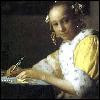
PS: the picture is a scan of her famous Scivias that I got via the Heidelberg University website to which the title is linked.
PPS: I'd like to own a dulcimer, it's so pretty!

mardi 23 décembre 2008

Apocalyptic time

ARTE, the French-German channel, is often considered boring– Americans would say "high-brow"–by the crowd, or, at best, educational. Actually it's the way people, who never watch it, see it. They miss many interesting varied programmes and good old films, or more recent films that weren't necessarily blockbusters, I admit, but usually worth seeing. And once every 5 years there's a terrific programme that constitutes a true revelation and goes straight in the history of television. It often happens this time of the year, and it's often provided by Gérard Mordillat and Jérôme Prieur.

This year it was a documentary series whose title L'Apocalypse could be seen as a mislead, but is actually relevant.

Several researchers (historians and theologians, Jewish, Catholics, Protestants, believers and atheists, whatever) from all over the world have contributed to that inquiry/explanation/exegesis in front of the camera, on the origins of Christian Church in the Roman Empire. The debate unfolds through the montage of the various speeches, but they basically talk to the camera, alone. There's a female voice-over to introduce a theme, a question, or make a transition but nothing else. The writers-directors never appear on screen. The approach is quite similar to the Corpus Christi series that aired 11 years ago (same writers-directors), which means it's scholastic and sober, severe even, but it's simply engrossing and fascinating. Corpus Christi was a success at the time and I'm sure that the dvds of L'Apocalypse already sell well. My point is that the audience can enjoy smart when you give them smart even when it doesn't look attractive nor entertaining.

Books talk to each others, so our researchers use several other sources to throw light on the Christian literature and articulate the demonstration; it isn't only a matter of exegesis for historical events are also examined to explain the beginning of Christianity.

The series begins with a study of the Book of Revelation, hence the title, and opens with the idea–actually it's a quote from Alfred Loisy and a leitmotiv throughout the series–that early Christians waited for the impending return of Christ but it's the Church that came. The writers of the series are no historians, their work isn't flawless, they may even be trapped in their own certainty and obsessions, unable to think "out of the box"for they don't see the box they are stuck in, but they make good and refreshing television; they do have a thesis since they built L'Apocalypse from the basic premise of a hiatus between the Jewish sect of Jesus followers and the institution that overcame in the Empire, and that thesis is conveyed by the voice-over, sometimes a bit heavily, but they let the scientists talk as they wish, which is the best part and makes the series gripping.

I've just seen the first episode, "La Synagogue de Satan"; I bought the dvds as my personal Christmas gift to myself; I loved it. It suggested very well how divided the first Christians were and that the New Testament is an unlikely collection of books that reveal the controversies of the time, the Canon having covered them up. I liked the idea that the Book of Revelation, written by John, followed a tendry Apocalyptic genre in Jewish literature, echoed the frustrations of many Jews after 70, and among them the frustration of those who believed in Jesus as the messiah and might have considered the others to be false jews(hence the phrase "synagogue of Satan"), but also gave away the competition between Jewish-Christians and Gentile-Christians, and might be, at the end of the day, a mere blistering attack against Paul and his followers.

The second isntallment goes back over the fire in Rome and the first persecution but I'm saving it for later, there's Doctor Who on the cable.

PS: Enluminure du commentaire de l'Apocalypse, Béatus El Escorial, 1ère moitié du Xème siècle, parce que la sans-dieu que je suis n'a pas oublié qu'elle était aussi médiéviste.

vendredi 19 décembre 2008

Shoe planning


The good thing about the Internet buzz concerning the Shoe Attack against Bush in Iraq is that now everybody seems to recall Khrushchev banging his shoe on the table at the UN in 1960.

Some people said that the shoe event was an example of Khrushchev's terrible temper and primal reactions but I have been told–I haven't seen the pictures myself– that he was actually still wearing both shoes on his feet at the time so he would have brought an extra shoe as a mere prop, cunningly premeditating the whole thing.

8 years before, Adlai Stevenson was running for the White House. He believed in the power of words but was caught with a hole in the sole of his shoe, and Eisenhower won the elections.


The Iraqi journalist that aimed at Bush, is said to have practised throwing shoes for weeks.


Morale de l'histoire? The political shoe must be at hand but requires planning.